
High-Resolution Measurements
RMS every 20 ms (4,000 samples/sec) for fast and accurate capture of electrical phenomena.
Our Technology
GES AI Beyond Monitoring
What GES measures
RMS every 20 ms (4,000 samples/sec) for fast and accurate capture of electrical phenomena.
Early identification of loose connections and abnormal resistance trends.
Measurement of unique parameters that indicate developing faults — beyond standard V, I and PQ.
End-to-end visibility: incoming supply, switchboards, UPS, generators, ATS/STS, critical loads and more. Not just the panel — the entire electrical chain.
All parameters are time-synchronized on the same time-stamp to reveal the true relationship between events.
Unique measurement and analysis methods protected by registered patents.
GES continuously collects high-resolution electrical data, including unique electrical parameters specifically designed to reveal developing faults and abnormal trends.
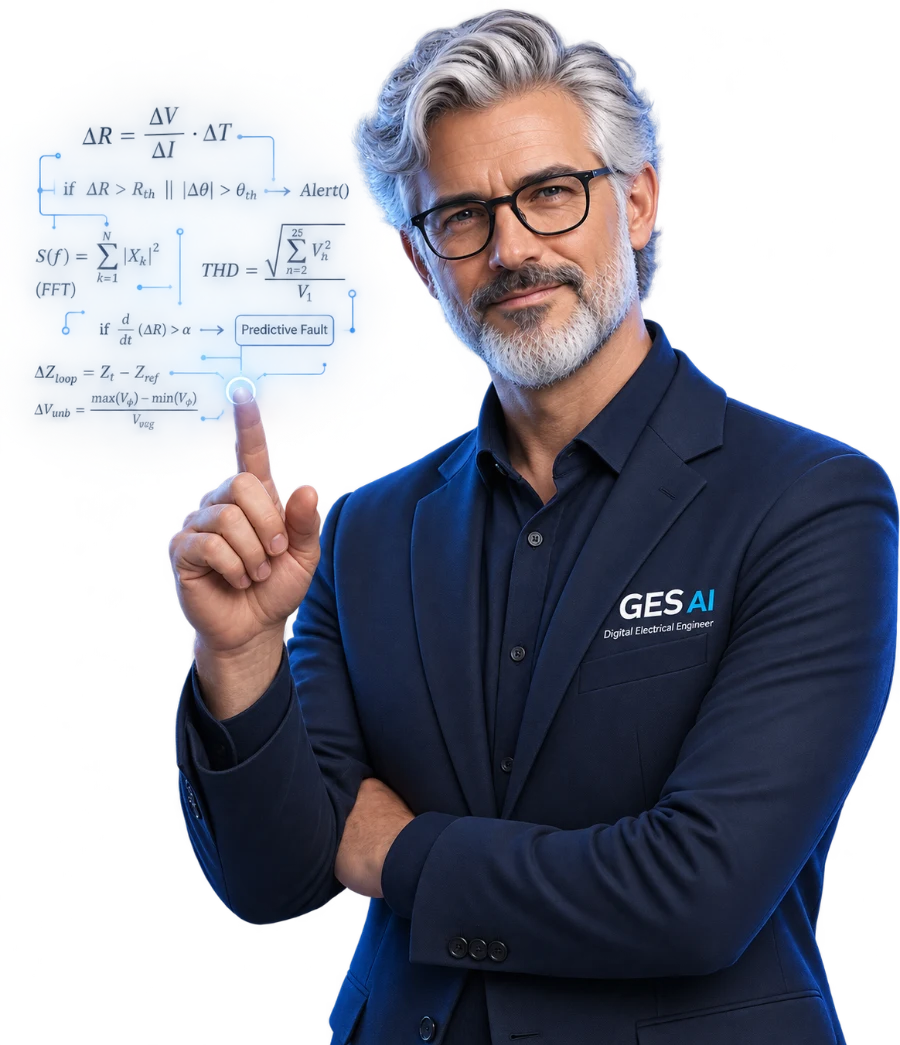
GES combines advanced electrical measurements with AI to identify patterns, detect deterioration, and automatically transform complex data into actionable engineering insights.
Enhanced FFT and signal-processing technology provides deeper visibility into electrical waveforms, harmonics, and abnormal signatures that conventional monitoring may miss.
GES measures energy and produces electricity bills based on time-of-use (TOU) tariffs, including detection of deviations from normal consumption patterns.
AI-Powered
Digital Electrical
Engineer
What GES delivers
Detects subtle patterns across equipment and time.
Identifies anomalies long before they become failures.
Delivers actionable insights engineers can trust.
GES AI
GES AI turns real-time electrical data into clear insights, early warnings, and confident engineering decisions.
Continuous. Accurate. Always available.
AI-powered analysis highlights what’s important.
Actionable recommendations to prevent failures.
Beyond standard metering
Conventional instruments report voltage, current and power quality — the state of the system right now. GES measures the parameters that change while a fault is still forming, on one synchronized time base, across the whole chain rather than a single panel.
ESP will map which panels to instrument first and what GES should be watching there.